Ocean Air Salty Hair Not a Care SVG
Let’s be real: not every beachy, breezy embroidery design holds up under needle and thread. I’ve stitched hundreds of coastal-themed files—from overworked seashell collages to minimalist wave motifs—and Ocean Air Salty Hair Not a Care SVG landed on my screen with an immediate, quiet confidence. It’s not shouting “vacation!” It’s whispering “salt-kissed ease,” and that subtlety is exactly what makes it work so well for real-world embroidery projects.
A Design That Breathes With Fabric
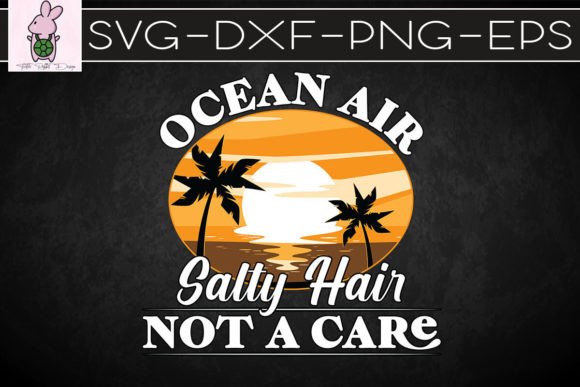
The first thing I noticed wasn’t the words—it was the negative space. The letterforms in Ocean Air Salty Hair Not a Care SVG are open, airy, and slightly uneven—like handwriting scrawled on a sun-bleached towel. There’s no heavy outlining, no dense fill stitches built into the vector shape (since it’s an SVG, not a pre-digitized embroidery file), which means you control how much texture and weight it carries. That’s a gift—not a limitation. For a custom embroidered tote bag destined for a seaside farmers’ market stall? This design feels handmade, relaxed, and intentional—not mass-produced or overly polished.
I opened it in my design software and scaled it to 4.5 inches wide—the sweet spot for a medium tote or a crewneck sweatshirt chest placement. The curves stayed smooth. The spacing between “Salty” and “Hair” gave just enough breathing room for satin stitch lettering without crowding. No jagged edges, no pixelation—even when zoomed in at 400%. That clean background in the included PNGs? A huge time-saver when building layered mockups for Etsy listings or client previews.
Where It Shines—and Where It Needs Thought
Ocean Air Salty Hair Not a Care SVG naturally belongs on relaxed, lifestyle-driven products: linen tea towels for a coastal kitchen boutique, organic cotton baby onesies (paired with a tiny anchor motif), lightweight denim aprons for artisan bakers, or unstructured canvas caps for surf shops. It reads effortlessly on light fabrics—cream, oat, sky blue—where the softness of the phrase mirrors the fabric’s drape.
But here’s where experience kicks in: this isn’t a one-size-fits-all embroidery file. Because it’s delivered as SVG, PNG, and DXF, it’s not ready-to-stitch out of the box. You’ll need to digitize it—or hire someone who does—for machine embroidery use. That means considering stitch density carefully. Thin script like this can disappear on dark fabric if fill stitches are too sparse, or look muddy if over-digitized with heavy underlay. I’d recommend a balanced satin stitch for letters, minimal underlay on stable fabrics like midweight cotton twill, and a lightweight tear-away stabilizer for tote bags or pillow covers.
It’s also not ideal for curved surfaces like baseball caps without significant reworking—those gentle arcs don’t translate smoothly to a rounded crown without distortion. And on stretchy fabrics (think slub cotton tees or ribbed knits), you’ll want to test tension and stabilizer pairing thoroughly. The delicate spacing between letters could close up or distort if the fabric shifts even slightly during hooping.
Real Project Test: A Coastal Nursery Pillow Cover
Last week, I used Ocean Air Salty Hair Not a Care SVG as the centerpiece for a 16-inch linen-cotton blend pillow cover—part of a small-batch nursery collection. I digitized it at 3.75 inches wide, used pale seafoam thread on natural linen, and kept stitch density low to preserve the airy feel. The result? Soft, legible, and deeply tactile—like something you’d find in a thoughtful boutique, not a craft fair booth with generic fonts. Customers commented on how “calm” it felt—proof that mood translates through stitch as much as screen.
What This Means for Your Craft Business
If you’re an Etsy seller or small shop owner, Ocean Air Salty Hair Not a Care SVG is a quietly strategic asset. It’s niche but broadly appealing—coastal, boho, minimalist, and gender-neutral all at once. That versatility helps you stretch one digital embroidery file across multiple product lines: holiday gift sets (“Salty Hair & Hot Cocoa”), personalized baby blankets, or summer pop-up shop merch.
But buyer trust hinges on execution. A poorly digitized version—too dense, wrong thread contrast, sloppy corners—undermines the entire vibe. So before listing your first embroidered sweatshirt, do these five things:
- Test the design on scrap fabric matching your final product (e.g., fleece for hoodies, terry cloth for towels)
- Check thread color contrast on both light and dark backgrounds using printable mockups
- Review small details—especially the tail of the “y” in “Salty” and the curve of the “a” in “Hair”—under magnification
- Confirm your commercial license allows finished product sales (the listing says “Digital Design Kit,” so verify usage rights before reselling digitized versions)
- Use proper stabilizer—lightweight cutaway for knits, tear-away for stable wovens—to keep those graceful lines crisp
Final Thought: Less Is Anchored Here
This isn’t a flashy, attention-grabbing embroidery file. It won’t dominate a tradeshow booth from across the room. But Ocean Air Salty Hair Not a Care SVG earns its place in your design assets because it supports intention—not impulse. It works for the customer who buys a handmade pillow cover not for the logo, but for the feeling it evokes. For the Etsy shopper scrolling slowly, pausing at the phrase “Salty Hair,” smiling, and adding it to cart because it *feels* like her.
In a market flooded with overdesigned, oversaturated graphics, restraint is rare—and valuable. Use Ocean Air Salty Hair Not a Care SVG thoughtfully, digitize it with respect for its rhythm, and it won’t just decorate your products. It’ll deepen their story.