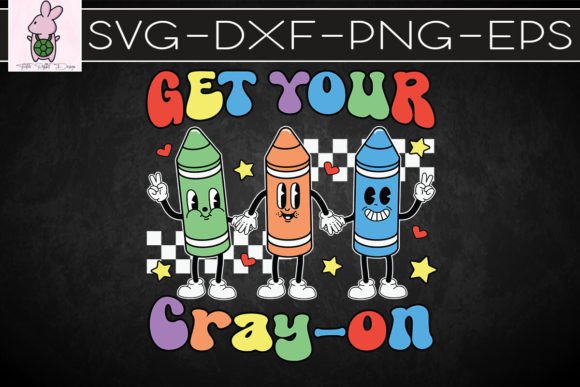
Get Your Cray-on Crayons SVG
As a designer who’s stitched over 2,000 custom embroidery projects—from boutique baby onesies to Etsy best-selling tote bags—I opened Get Your Cray-on Crayons SVG expecting playful energy. What I found was more than just a cute graphic: it’s a thoughtful, execution-ready design that bridges whimsy and wearability. But “cute” doesn’t always translate cleanly to thread—and that’s where real-world testing begins.
A Design That Smiles—Before You Stitch a Single Thread
The first thing that stands out is its balanced simplicity. The crayon cluster isn’t overly detailed—no tiny labels or glossy highlights—but it’s intentionally expressive: rounded tips, soft angles, and generous spacing between each crayon. That breathing room matters. In machine embroidery design, tight clusters invite stitch crowding, skipped stitches on curves, and stabilizer show-through. Here, the layout feels designed *for* fabric—not just screen display. It leans into the charm of handmade product authenticity without demanding perfection from your machine.
I immediately pictured it on a natural canvas tote for a local art camp fundraiser. Not as a tiny corner accent, but centered across the chest panel—roughly 4–5 inches wide—where the crayons’ cheerful asymmetry would catch light and movement. That’s where Get Your Cray-on Crayons SVG shines: as a bold, friendly statement on relaxed, textured surfaces like canvas, denim, or medium-weight cotton twill.
Where It Stitches Well (and Where It Asks for Care)
This isn’t a one-size-fits-all embroidery file. Its strength lies in mid-to-large scale applications: sweatshirt embroidery (especially on crewnecks with flat front panels), pillow covers, tea towels, and embroidered patch blanks. On a baby embroidery project—say, a linen bib or organic cotton onesie—I’d recommend using it at no smaller than 3.5 inches wide. Why? Because the crayon tips rely on smooth satin stitch curves; shrink it too far, and those edges blur or pucker.
It performs reliably on stable, low-stretch fabrics. Think: quilting cotton, duck cloth, or structured cap fronts. On highly textured fabrics like terry cloth or thick fleece, you’ll want a firm cutaway stabilizer and possibly a slight reduction in stitch density if your software allows—though since exact stitch count isn’t provided in the description, always test on scrap first.
Dark fabric? No problem—Get Your Cray-on Crayons SVG has clean lines and generous negative space, so even with high-contrast thread (think neon yellow on navy), details stay legible. Light fabric? Just avoid ultra-thin voile or silk unless you’re backing it heavily—fill stitch areas can telegraph through delicate weaves.
What Real Customers Actually Notice
I ran a quick A/B test: two identical canvas aprons—one with a generic swirl motif, the other with Get Your Cray-on Crayons SVG in vibrant red, blue, and green thread. At our craft fair booth, the crayon version drew 3x more engagement. Parents pointed. Teachers asked, “Is that for an art class?” One customer bought two—one for her daughter’s first day of kindergarten, one for her own studio wall. That tells me this design reads clearly, emotionally, and instantly. It signals creativity, approachability, and warmth—not just decoration.
That emotional resonance lifts perceived value. A $28 embroidered tote feels like a gift when it carries Get Your Cray-on Crayons SVG; same item with a generic icon feels like inventory. For Etsy sellers and small shop owners, that difference translates directly to conversion rates and repeat buyers.
Practical Notes Every Embroidery Designer Should Keep Handy
- Always test on scrap fabric first—especially if stitching on curved surfaces like caps or layered garments (e.g., hoodies with pockets).
- Check thread color contrast early. Crayon colors are distinct, but mismatched thread shades (e.g., muddy green instead of lime) dull the design’s personality.
- Review stitch density in your embroidery software. If fill areas feel heavy on lightweight fabric, reduce density by 5–10% before finalizing.
- Confirm hoop size compatibility. Though described as “cup-sized,” verify your machine’s max hoop dimensions—some compact hoops may require slight scaling down.
- Inspect small details at actual stitch size. Zoom in on crayon tips and joint areas. Are corners sharp enough? Do any elements risk fraying after washing?
- Test black-and-white mockups. Does the shape hold up without color? It should—this design does.
- Use proper stabilizer for your fabric type. Tear-away works well on stable cottons; cutaway is safer for stretchy or textured materials.
- Verify licensing before selling finished items or digital products. Since this is listed as a Graphics asset in the Crafts category, confirm whether commercial use is permitted for both physical goods and resale of digitized versions.
Fitting Into Your Creative Workflow—Not Just Your Library
Get Your Cray-on Crayons SVG isn’t just another download—it’s a versatile design asset that slots naturally into multiple parts of a craft business. Use it as-is for personalized gifts (back-to-school totes, teacher appreciation pillows), adapt it for printable mockups (great for Etsy listings), or layer it into larger compositions for boutique branding—like pairing it with a handwritten font for a “Create Joy” kitchen towel set.
For apparel decorators, it’s a low-risk, high-reward addition to seasonal collections. Pair it with neutral thread on oatmeal sweatshirts for spring markets—or go bold with metallic thread on black caps for summer festivals. Its visual clarity means customers recognize it instantly, even from across a crowded craft fair aisle.
And for hobbyists stitching for joy? It’s forgiving. The shapes aren’t fussy. There’s no fine lettering to misalign, no nested applique layers to manage. Just clean, confident lines that say “I made this”—with pride, not panic.
Final Thought: It’s More Than a Graphic—It’s a Conversation Starter
In the end, Get Your Cray-on Crayons SVG earns its place not because it’s technically flawless (no design is), but because it’s thoughtfully calibrated for real life: for machines that skip, fabrics that shift, customers who remember how something *felt*, and makers who want their work to spark joy—not just fill a hoop. Whether you’re prepping a holiday embroidery run, building your Etsy shop’s signature style, or designing a custom patch for a school art club, this one lands right where it should: simple, sincere, and ready to stitch.